
The Importance of Strategic PCB Fan-out
Using Fan-out to give you optimal performance and create space in your design
Phillip Restall
9/2/20253 min read
Most modern PCB design tools will help you fan-out your entire PCB. This can be fine on some boards but when working with high-pin-count BGAs, it’s worth asking yourself a few key questions:
How many traces can you squeeze between each via?
Will I be routing differential pairs?
Do I have decoupling capacitors that need to go as close to power pins as possible?
If it's an FPGA can I utilise pin swapping?
Will I be routing differential pairs?
The chances are you will only be able to route one trace between each via or if you are lucky, two.
Differential pairs add extra complexity since they must be routed together as a pair and usually need a wider gap to maintain the correct impedance. This, in most cases, will mean there is not enough room between vias to keep them tightly coupled.
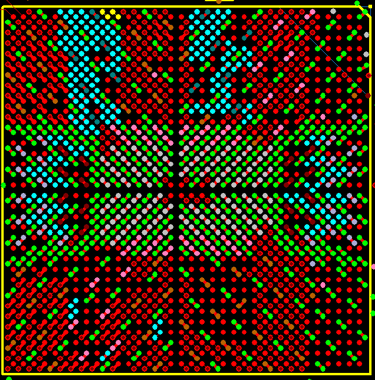
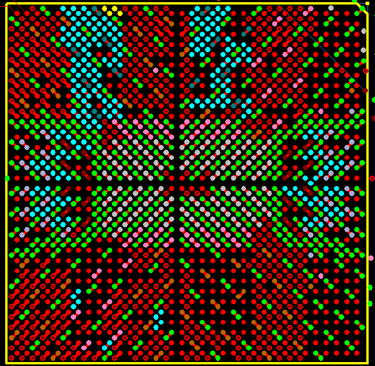
Standard practice when you fan-out a BGA is away from the center so you end up with a cross that is centrally located but do keep in mind that this channel can be moved to suit your needs.
The example shown has a channel offset slightly to the right to allow a critical differential pair to be routed.
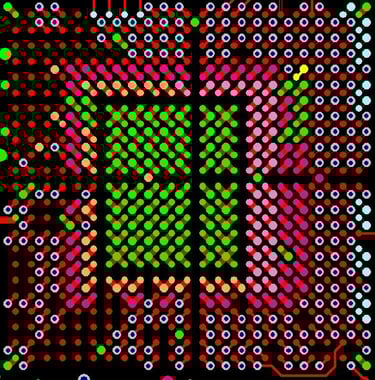
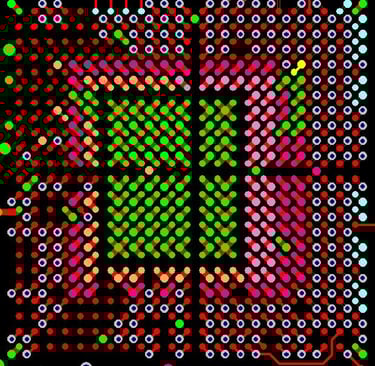
Do I have decoupling capacitors that need to go as close to power pins as possible?
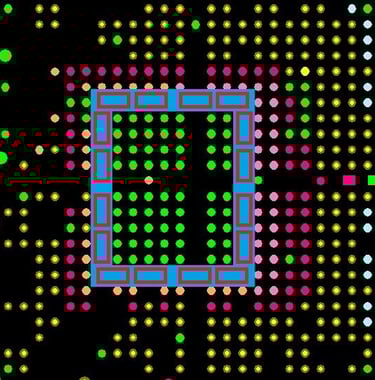
Depending on the device pin-out and how populated it is, you may be able to create additional space in your fan-out pattern for capacitors
Colour-coding nets is highly recommended to make it easier to see what’s happening so you can formulate your strategy.
In the example shown, I shared some GND pins (green) between vias on the device.
This allowed me to open up the rectangular channel (blue). This allowed me to get some decoupling capacitors directly on the pins of the device for all 3 voltages present.
If it's an FPGA can I utilise pin swapping?
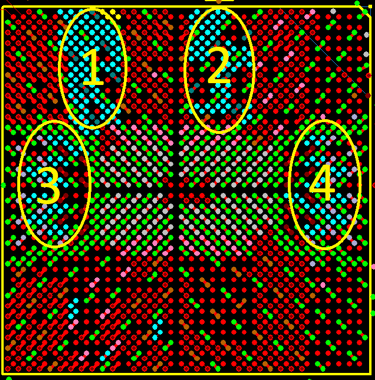
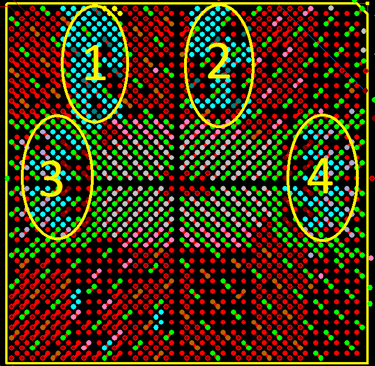
Sometimes you’ll have the flexibility to swap entire banks or individual pins to make routing easier.
This can become essential on really tight boards but can often become cumbersome and time consuming as most tools don't support this very well. You may have to adjust the schematic, which then forces you to re-do your fan-out when syncing
The example shown had 4 swap-able banks. Utilising these swaps was hugely beneficial but you need to make the decision early.
Don't just fan-out and forget
Many designers just see the fan-out of BGAs as one of their many tasks: Placement > Fan-out > Routing. Once they fan-out, they fix all the vias and forget.
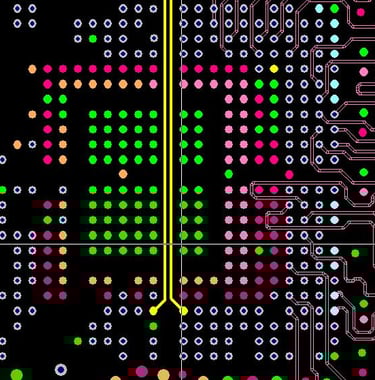
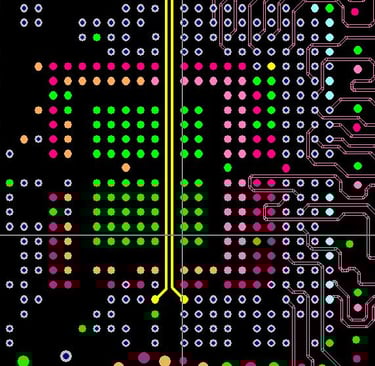
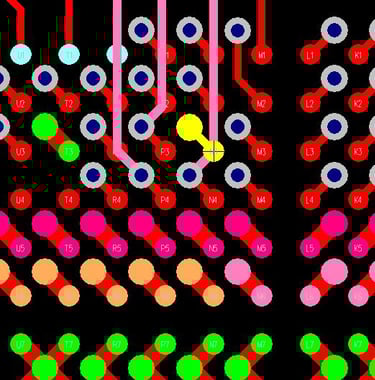
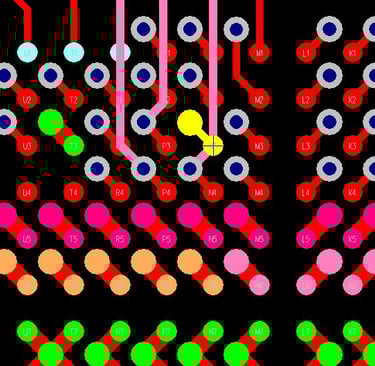
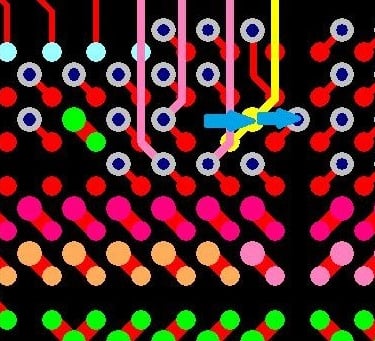
Shifting vias about within the BGA can often give you a "get out of jail free card". If you have a route on a via that has nowhere to go, look to see the effect of shifting it over one, then see if its possible by shifting other vias.
In the example, the yellow via was trapped and could not be routed on the desired layer. By moving 2 vias to the right, it made it possible to easily route out the desired trace.
“Good BGA fan-out isn’t just about getting signals out- it’s about planning flexibility, making space for critical components and leaving yourself options when the routing gets tough.”
Have we missed anything? share your tips now!
CAPABILITIES AND SERVICES
Contact
info@cadextreme.com
© 2026. All rights reserved.
PCB Layout Designs 50 LAyers+
Rigid, Flex, Flex-rigid, HDI, High-speed, Power boards
Blind/buried vias
Library Creation
Project migration
Schematic updates
3d modeling and technical drawing
Altium (PCB / Schematic)
Siemens Xpedition (PCB / Schematic)
Siemens PADs (PCB / Schematic)
Cadence Allegro / Orcad (PCB / Schematic)
SolidEdge (3d)
Solidworks (3d)
Autocad (2d)
main software supported

